Stocks traced a V-shaped path last week, dipping to midweek lows before chip stocks and big tech names led a strong recovery, even as Middle East conflict resumed and the Fed’s June meeting minutes revealed a central bank openly divided on its next move.
The Numbers
- S&P 500: +1.23%
- Nasdaq: +1.74%
- Dow Jones Industrial Average: −0.50%
- MSCI EAFE: −1.42%
U.S. large-cap and tech indexes finished positive while the Dow slipped and international markets pulled back — reflecting the renewed geopolitical uncertainty that weighed more heavily on non-U.S. equities. The week’s shape matters as much as the outcome: markets absorbed bad news and finished strong.
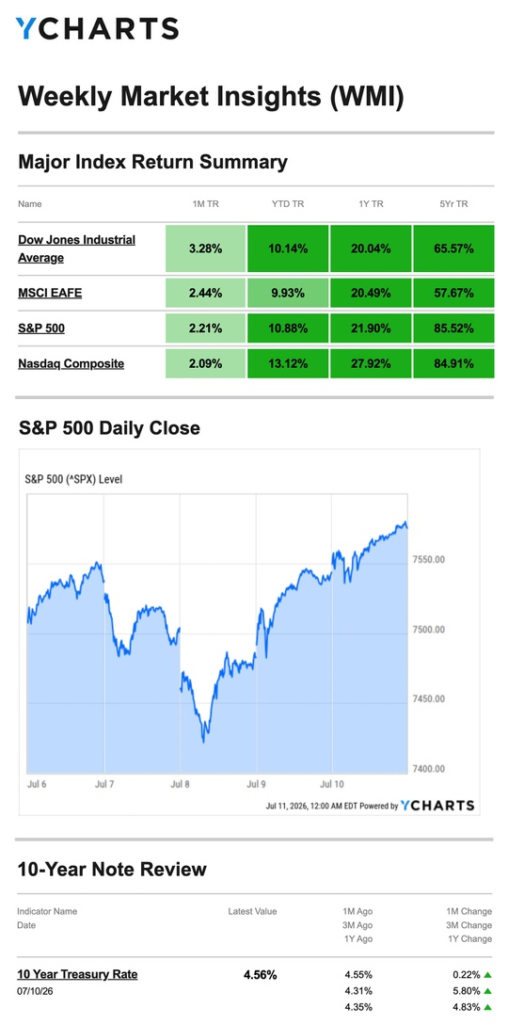
Source: YCharts.com, July 11, 2026. Weekly performance is measured from Monday, July 6, to Friday, July 10. TR = total return for the index, which includes any dividends and cash distributions during the period. Treasury note yield is expressed in basis points.
What Happened
Monday: AI Trade Roars Back
Stocks opened the week on a firm footing as investors shook off concerns about AI valuations that had pressured tech names in recent weeks. The Dow hit another record close, and the Nasdaq climbed more than 1% as chip stocks led the renewed enthusiasm for the AI trade.
Tuesday–Wednesday: Midweek Slide, Then Recovery
The Dow reached a new intraday high on Tuesday before beginning a two-day slide. All three major averages hit their weekly lows around midday Wednesday, but the Nasdaq eked out a slight gain on the session as chip stocks recovered before the close, foreshadowing the broader recovery to come.
Thursday–Friday: V-Shape Completes
Stocks climbed steadily through the back half of the week. Semiconductor stocks led the rally even as reports emerged that mediators were working to bring the U.S. and Iran back to the negotiating table, a sign that headlines of renewed conflict are losing some of their power to derail the AI and tech trade. A handful of major tech names drove broad market gains Friday, with the S&P 500 and Nasdaq each adding more than 1% on the session to close the week strongly.
The Fed’s “Family Fight”
Wednesday’s release of June FOMC meeting minutes offered a rare unfiltered look at a Federal Reserve in genuine disagreement, and the picture is more unsettled than the steady public messaging has suggested.
Fed officials debated opposing positions at the June meeting, with some arguing for rate hikes to combat persistent inflation and others pushing back against tightening into a slowing economy. Chair Warsh described the internal debate as a “family fight” and deliberately offered little forward guidance, indicating the Fed would continue assessing incoming inflation data before committing to a direction.
The implications are significant. A Fed that is openly divided is harder for markets to read and price around. With headline CPI still elevated, core PCE at a multi-year high, and a jobs market that just posted a significant miss, policymakers are navigating genuinely conflicting signals. Tuesday’s CPI report and Warsh’s Congressional testimony will be the most important inputs into that debate this week.
What We’re Watching
Tuesday: CPI and Warsh Testimony — the Week’s Defining Moment
Two critical events land on the same day. The June Consumer Price Index will be the first inflation reading since the peace deal was announced and oil prices began to pull back. If energy-driven price pressure is easing, the headline number should reflect it. Simultaneously, Chair Warsh presents the Fed’s Monetary Policy Report to Congress, his most significant public appearance since taking office. Markets will be listening for any shift in tone from the “family fight” posture revealed in the minutes.
Wednesday’s PPI
Wholesale inflation data arrives the following day, completing the week’s inflation picture. With the Fed divided on whether to hike or hold, two consecutive days of inflation data could decisively shift the internal debate.
Conflict Resumption and Market Resilience
Perhaps the most notable development of the week was that markets finished higher despite renewed Middle East conflict and reports of stalled negotiations. That resilience — particularly in chip stocks and AI names — suggests investors are becoming more willing to look past geopolitical noise and focus on earnings fundamentals. Whether that confidence is justified will be tested as the conflict evolves.
This Week’s Critical Data
- Tuesday: Consumer Price Index (CPI); Fed Chair Warsh Congressional Testimony
- Wednesday: Producer Price Index (PPI); Fed Beige Book
- Thursday: Retail Sales; Weekly Jobless Claims
Source: Investors Business Daily – Econoday economic calendar; July 10, 2026. Forecasts are subject to revision and may not materialize.
As always, if you have any questions about your portfolio or want to discuss your strategy, please don’t hesitate to reach out.

Crescent Private Wealth
Weekly Market Insights
Talk To Us!
Footnotes And Sources
WSJ.com, July 10, 2026
Investing.com, July 10, 2026
WSJ.com, July 6, 2026
CNBC.com, July 7, 2026
CNBC.com, July 8, 2026
CNBC.com, July 9, 2026
CNBC.com, July 10, 2026
CNBC.com, July 8, 2026
Investing involves risks, and investment decisions should be based on your own goals, time horizon, and tolerance for risk. The return and principal value of investments will fluctuate as market conditions change. When sold, investments may be worth more or less than their original cost.
The forecasts or forward-looking statements are based on assumptions, may not materialize, and are subject to revision without notice.
The market indexes discussed are unmanaged, and generally, considered representative of their respective markets. Index performance is not indicative of the past performance of a particular investment. Indexes do not incur management fees, costs, and expenses. Individuals cannot directly invest in unmanaged indexes. Past performance does not guarantee future results.
The Dow Jones Industrial Average is an unmanaged index that is generally considered representative of large-capitalization companies on the U.S. stock market. The Nasdaq Composite is an index of the common stocks and similar securities listed on the Nasdaq stock market and considered a broad indicator of the performance of stocks of technology and growth companies. The MSCI EAFE Index was created by Morgan Stanley Capital International (MSCI) and serves as a benchmark of the performance of major international equity markets, as represented by 21 major MSCI indexes from Europe, Australia, and Southeast Asia. The S&P 500 Composite Index is an unmanaged group of securities that are considered to be representative of the stock market in general.
U.S. Treasury Notes are guaranteed by the federal government as to the timely payment of principal and interest. However, if you sell a Treasury Note prior to maturity, it may be worth more or less than the original price paid. Fixed income investments are subject to various risks including changes in interest rates, credit quality, inflation risk, market valuations, prepayments, corporate events, tax ramifications and other factors.
International investments carry additional risks, which include differences in financial reporting standards, currency exchange rates, political risks unique to a specific country, foreign taxes and regulations, and the potential for illiquid markets. These factors may result in greater share price volatility.