Stocks declined last week as AI disruption fears resurfaced across a broad range of industries and a hotter-than-expected wholesale inflation report added to investor unease heading into the weekend.
The Numbers
- S&P 500: −0.44%
- Nasdaq: −0.95%
- Dow Jones Industrial Average: −1.27%
- MSCI EAFE: +1.22%
U.S. equities fell across the board, with the Dow underperforming despite still leading the S&P 500 and Nasdaq year-to-date. International developed markets again outperformed their U.S. counterparts.
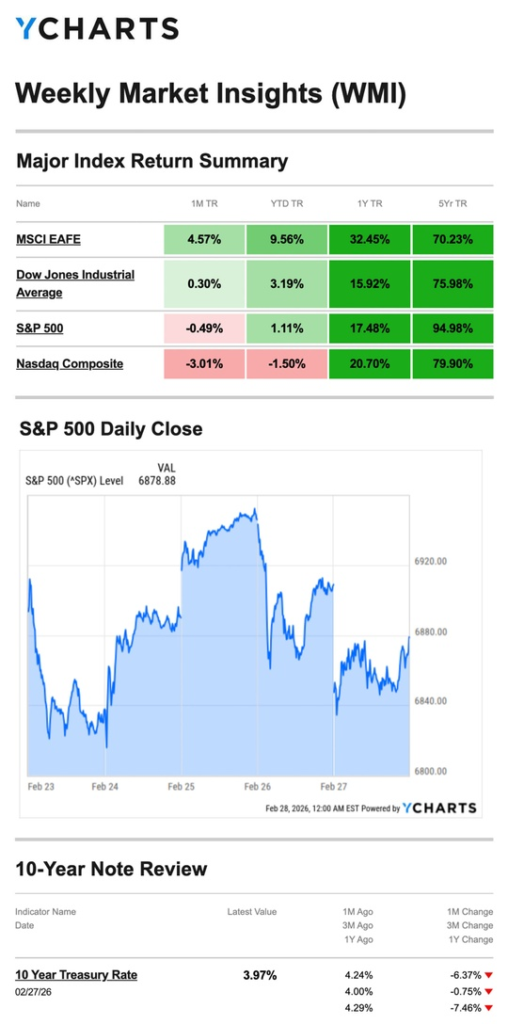
Source: YCharts.com, February 28, 2026. Weekly performance is measured from Monday, February 23, to Friday, February 27. TR = total return for the index, which includes any dividends as well as any other cash distributions during the period. Treasury note yield is expressed in basis points.
What Happened
Monday: AI Fears Broaden Markets opened under pressure as a new research report circulating among traders suggested AI’s economic impact could be wider than previously understood — potentially affecting unemployment across a range of industries beyond tech. The selloff was broad.
Tuesday–Wednesday: Relief Rally Investors stepped back in over the next two sessions, seeing opportunity in what appeared to be an oversold trade. Software, cybersecurity, and AI-related technology shares led the rebound. Momentum was further fueled by anticipation around a prominent AI chipmaker’s upcoming Q4 earnings report, pushing all three major averages higher across both days.
Thursday–Friday: Selling Resumes The relief proved short-lived. Markets declined over the final two sessions, with the Dow leading losses on both days. Friday’s weakness was compounded by a wholesale inflation report that came in above expectations — a reminder that inflation remains an unresolved challenge for the Fed.
Wholesale Inflation Rises Friday’s Producer Price Index (PPI) — delayed from its original release date due to the government shutdown — showed wholesale prices rose 0.5% in January, above the 0.3% economists had expected. PPI measures what businesses pay to produce goods and deliver services. When those costs rise faster than anticipated, the concern is that companies eventually pass them along to consumers, keeping overall inflation elevated and complicating the Fed’s path toward its 2% target.
With consumer inflation also running above target, this week’s data calendar takes on added significance.
What We’re Watching
AI as a Sustained Market Theme Last week marked the second consecutive week in which AI disruption fears drove meaningful market moves. This is no longer a one-off event — it’s becoming a recurring variable that investors are actively pricing. The question is whether AI’s impact on corporate earnings and employment will prove disruptive enough to alter the broader growth outlook.
Friday’s Jobs Report The federal employment report — also delayed by the shutdown — arrives Friday and will be closely watched. Last week’s PPI surprise and ongoing AI anxiety make a strong labor market reading all the more important for sustaining investor confidence.
The Inflation–Growth Tension Rising wholesale prices alongside slowing growth creates a difficult backdrop for the Fed. With no rate decision until mid-March, this week’s data — particularly the ADP report Wednesday and the jobs report Friday — will shape how markets interpret the Fed’s next move.
This Week’s Critical Data
- Wednesday: ADP Employment Report; ISM Services; Fed Beige Book
- Friday: Federal Employment Report (delayed)
Source: Investors Business Daily – Econoday economic calendar; February 27, 2026. Forecasts are subject to revision and may not materialize.
As always, if you have any questions about your portfolio or want to discuss your strategy, please don’t hesitate to reach out.

Crescent Private Wealth
Weekly Market Insights
Talk To Us!
Footnotes And Sources
WSJ.com, February 27, 2026
Investing.com, February 27, 2026
CNBC.com, February 23, 2026
CNBC.com, February 25, 2026
WSJ.com, February 27, 2026
WSJ.com, February 27, 2026
IRS.gov, August 18, 2025
Investing involves risks, and investment decisions should be based on your own goals, time horizon, and tolerance for risk. The return and principal value of investments will fluctuate as market conditions change. When sold, investments may be worth more or less than their original cost.
The forecasts or forward-looking statements are based on assumptions, may not materialize, and are subject to revision without notice.
The market indexes discussed are unmanaged, and generally, considered representative of their respective markets. Index performance is not indicative of the past performance of a particular investment. Indexes do not incur management fees, costs, and expenses. Individuals cannot directly invest in unmanaged indexes. Past performance does not guarantee future results.
The Dow Jones Industrial Average is an unmanaged index that is generally considered representative of large-capitalization companies on the U.S. stock market. The Nasdaq Composite is an index of the common stocks and similar securities listed on the Nasdaq stock market and considered a broad indicator of the performance of stocks of technology and growth companies. The MSCI EAFE Index was created by Morgan Stanley Capital International (MSCI) and serves as a benchmark of the performance of major international equity markets, as represented by 21 major MSCI indexes from Europe, Australia, and Southeast Asia. The S&P 500 Composite Index is an unmanaged group of securities that are considered to be representative of the stock market in general.
U.S. Treasury Notes are guaranteed by the federal government as to the timely payment of principal and interest. However, if you sell a Treasury Note prior to maturity, it may be worth more or less than the original price paid. Fixed income investments are subject to various risks including changes in interest rates, credit quality, inflation risk, market valuations, prepayments, corporate events, tax ramifications and other factors.
International investments carry additional risks, which include differences in financial reporting standards, currency exchange rates, political risks unique to a specific country, foreign taxes and regulations, and the potential for illiquid markets. These factors may result in greater share price volatility.