Stocks ended last week modestly lower after a volatile stretch driven by economic data releases, geopolitical headlines, and renewed Federal Reserve uncertainty. Despite intraday swings, markets largely digested the noise and finished the week near flat.
The Numbers
- S&P 500: −0.38%
- Nasdaq: −0.66%
- Dow Jones Industrial Average: −0.29%
- MSCI EAFE: +1.41%
U.S. equities struggled for direction as investors weighed inflation data, policy headlines, and earnings results. International markets outperformed as overseas sentiment remained relatively stable.
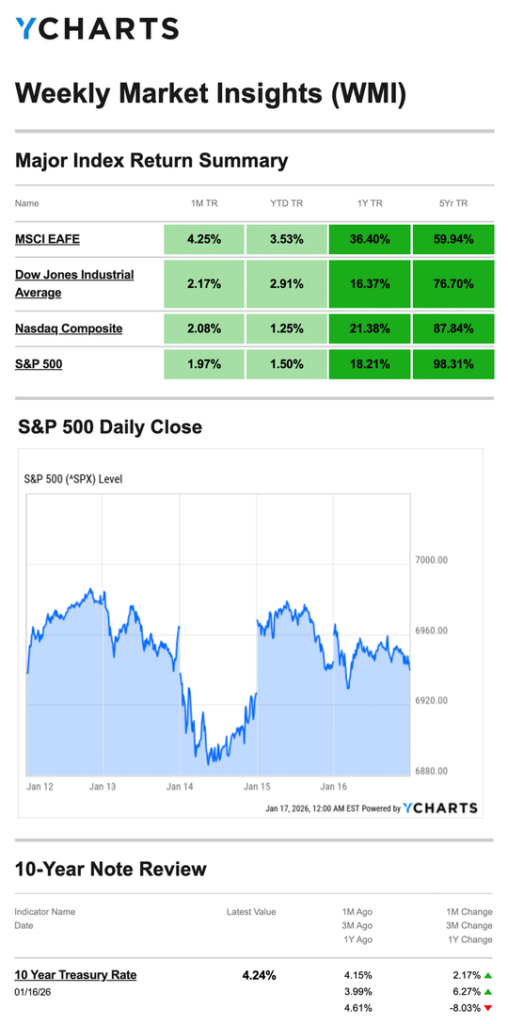
Source: YCharts.com, January 17, 2026. Weekly performance is measured from Monday, January 12, to Friday, January 16. TR = total return for the index, which includes any dividends and cash distributions during the period. Treasury note yield is expressed in basis points.
What Happened
Early Week: Volatility Returns
Markets opened lower after reports surfaced that the Department of Justice had launched a criminal investigation involving Federal Reserve Chair Jerome Powell. The headline injected uncertainty early in the week and pressured equities across sectors. A coordinated statement from global central bankers on Tuesday helped calm markets and reduce volatility.
Mid-Week: Inflation and Policy Headlines
Financial stocks came under pressure after the White House proposed a temporary 10% cap on credit card interest rates. Meanwhile, inflation data showed headline CPI in line with expectations while core inflation came in slightly cooler—news that investors viewed favorably.
Despite solid retail sales and wholesale inflation data for November, geopolitical tensions and weaker-than-expected fourth-quarter earnings from select financial institutions weighed on sentiment midweek.
Late Week: Partial Rebound
Chipmakers and banks led a rebound later in the week, helping markets recover most of their earlier losses. Stocks opened higher Friday before slipping again after the president walked back comments regarding a preferred candidate for the next Fed Chair—raising concerns about future monetary policy flexibility.
Fed Drama
Tensions between the White House and the Federal Reserve escalated following the Justice Department’s indictment of Chair Powell. Known for his measured approach, Powell responded with an unusually assertive public statement over the weekend.
By week’s end, markets appeared to look past the Fed-related headlines as attention shifted back toward economic data and earnings.
What We’re Watching
Policy Stability
Markets are increasingly sensitive to signals around Federal Reserve independence and future rate policy. Any perception of political pressure could amplify volatility.
Inflation Trajectory
Cooling core inflation remains supportive for markets, but investors will be watching closely for confirmation that price pressures are continuing to ease.
* indicates publication of a report delayed by the government shutdown in October and November
Source: Investors Business Daily – Econoday economic calendar; January 9, 2026. The Econoday economic calendar lists upcoming U.S. economic data releases (including key economic indicators), Federal Reserve policy meetings, and speaking engagements of Federal Reserve officials. The content is developed from sources believed to provide accurate information. The forecasts or forward-looking statements are based on assumptions and may not materialize. The forecasts are also subject to revision.
As always, if you have any questions about your portfolio or want to discuss your strategy, please don’t hesitate to reach out.

Crescent Private Wealth
Weekly Market Insights
Talk To Us!
Footnotes And Sources
1 .WSJ.com, January 16, 2026
2. Investing.com, January 16, 2026
3. CNBC.com, January 12, 2026
4. WSJ.com, January 12, 2026
5. CNBC.com, December 31, 2025
6. CDC.gov, August 25, 2025
7. CNBC.com, January 16, 2026
Investing involves risks, and investment decisions should be based on your own goals, time horizon, and tolerance for risk. The return and principal value of investments will fluctuate as market conditions change. When sold, investments may be worth more or less than their original cost.
The forecasts or forward-looking statements are based on assumptions, may not materialize, and are subject to revision without notice.
The market indexes discussed are unmanaged, and generally, considered representative of their respective markets. Index performance is not indicative of the past performance of a particular investment. Indexes do not incur management fees, costs, and expenses. Individuals cannot directly invest in unmanaged indexes. Past performance does not guarantee future results.
The Dow Jones Industrial Average is an unmanaged index that is generally considered representative of large-capitalization companies on the U.S. stock market. The Nasdaq Composite is an index of the common stocks and similar securities listed on the Nasdaq stock market and considered a broad indicator of the performance of stocks of technology and growth companies. The MSCI EAFE Index was created by Morgan Stanley Capital International (MSCI) and serves as a benchmark of the performance of major international equity markets, as represented by 21 major MSCI indexes from Europe, Australia, and Southeast Asia. The S&P 500 Composite Index is an unmanaged group of securities that are considered to be representative of the stock market in general.
U.S. Treasury Notes are guaranteed by the federal government as to the timely payment of principal and interest. However, if you sell a Treasury Note prior to maturity, it may be worth more or less than the original price paid. Fixed income investments are subject to various risks including changes in interest rates, credit quality, inflation risk, market valuations, prepayments, corporate events, tax ramifications and other factors.
International investments carry additional risks, which include differences in financial reporting standards, currency exchange rates, political risks unique to a specific country, foreign taxes and regulations, and the potential for illiquid markets. These factors may result in greater share price volatility.