Stocks were mixed last week as investors balanced a busy stretch of Q4 earnings, a widely expected Fed decision, and several economic reports that complicated the outlook heading into February.
The Numbers
- S&P 500: +0.34%
- Nasdaq: −0.17%
- Dow Jones Industrial Average: −0.42%
- MSCI EAFE: +1.22%
U.S. equities were split, with large-cap indexes diverging modestly. International developed markets continued to outperform.
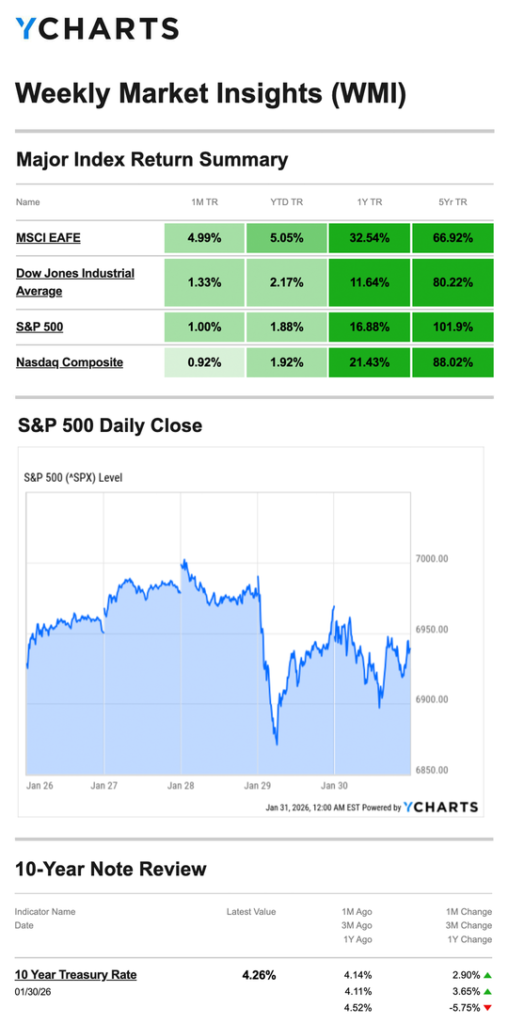
Source: YCharts.com, January 31, 2026. Weekly performance is measured from Monday, January 26, to Friday, January 30. TR = total return for the index, which includes any dividends and cash distributions during the period. Treasury note yield is expressed in basis points.
What Happened
Early Week: S&P 500 Touches 7,000 Equities advanced early as investors looked ahead to the Fed meeting and a heavy slate of earnings from large-cap companies, briefly pushing the S&P 500 to the 7,000 level.
Mid-Week: Fed Holds, Earnings Disappoint The Federal Reserve held rates steady on Wednesday, as broadly anticipated — the first pause since July, following three consecutive cuts. The fed funds rate remains in the 3.50%–3.75% target range. Market reaction to the Fed was muted. However, disappointing earnings from a major technology company, reported after Wednesday’s close, weighed on sentiment and dragged the Nasdaq lower on Thursday.
Late Week: New Headwinds Emerge Stocks opened lower Friday after the White House nominated Fed veteran Kevin Warsh as the next Fed chair. A warmer-than-expected wholesale inflation reading for December and renewed concerns about a potential government shutdown added to selling pressure as the week closed out.
The Fed Holds Steady The January meeting marked the first time the Fed paused since July, ending a run of three straight rate cuts. With the next Fed meeting not until mid-March, markets will have several weeks of data — including this week’s jobs report — to recalibrate expectations around the pace of future cuts.
What We’re Watching
Fed Leadership Transition The nomination of Kevin Warsh as the next Fed chair introduces a new variable for markets. Warsh is known as a hawk on inflation, and his eventual confirmation could shift tone and expectations around monetary policy.
Inflation Staying Warm December’s hotter-than-expected wholesale inflation data is a reminder that the path back to the Fed’s 2% target isn’t linear. Upcoming price reports will be closely watched.
Jobs Market in Focus Friday’s Jobs Report is the marquee release this week, alongside Consumer Sentiment — both will offer important reads on whether the consumer-driven resilience of 2025 is carrying into the new year.
This Week’s Critical Data
- Wednesday: ADP Employment Report
- Friday: Jobs Report; Consumer Sentiment
These releases will shape expectations around inflation trends and the Fed’s policy path early in 2026.
Source: Investors Business Daily – Econoday economic calendar; January 30, 2026. Forecasts are subject to revision and may not materialize.
As always, if you have any questions about your portfolio or want to discuss your strategy, please don’t hesitate to reach out.

Crescent Private Wealth
Weekly Market Insights
Talk To Us!
Footnotes And Sources
WSJ.com, January 30, 2026
Investing.com, January 30, 2026
CNBC.com, January 26, 2026
CNBC.com, January 27, 2026
CNBC.com, January 28, 2026
WSJ.com, January 29, 2026
CNBC.com, January 30, 2026
WSJ.com, January 28, 2026
IRS.gov, July 8, 2025
Investing involves risks, and investment decisions should be based on your own goals, time horizon, and tolerance for risk. The return and principal value of investments will fluctuate as market conditions change. When sold, investments may be worth more or less than their original cost.
The forecasts or forward-looking statements are based on assumptions, may not materialize, and are subject to revision without notice.
The market indexes discussed are unmanaged, and generally, considered representative of their respective markets. Index performance is not indicative of the past performance of a particular investment. Indexes do not incur management fees, costs, and expenses. Individuals cannot directly invest in unmanaged indexes. Past performance does not guarantee future results.
The Dow Jones Industrial Average is an unmanaged index that is generally considered representative of large-capitalization companies on the U.S. stock market. The Nasdaq Composite is an index of the common stocks and similar securities listed on the Nasdaq stock market and considered a broad indicator of the performance of stocks of technology and growth companies. The MSCI EAFE Index was created by Morgan Stanley Capital International (MSCI) and serves as a benchmark of the performance of major international equity markets, as represented by 21 major MSCI indexes from Europe, Australia, and Southeast Asia. The S&P 500 Composite Index is an unmanaged group of securities that are considered to be representative of the stock market in general.
U.S. Treasury Notes are guaranteed by the federal government as to the timely payment of principal and interest. However, if you sell a Treasury Note prior to maturity, it may be worth more or less than the original price paid. Fixed income investments are subject to various risks including changes in interest rates, credit quality, inflation risk, market valuations, prepayments, corporate events, tax ramifications and other factors.
International investments carry additional risks, which include differences in financial reporting standards, currency exchange rates, political risks unique to a specific country, foreign taxes and regulations, and the potential for illiquid markets. These factors may result in greater share price volatility.