Stocks were mixed last week, with strong gains on Monday and Friday framing a difficult stretch in between, as investors worked through a heavy wave of Q4 earnings and troubling signals from the labor market.
The Numbers
- S&P 500: −0.10%
- Nasdaq: −1.84%
- Dow Jones Industrial Average: +2.50%
- MSCI EAFE: +0.49%
A striking divergence within U.S. markets: the Dow posted its best week in some time while the Nasdaq lagged sharply, reflecting a notable rotation out of technology and into more economically sensitive sectors.
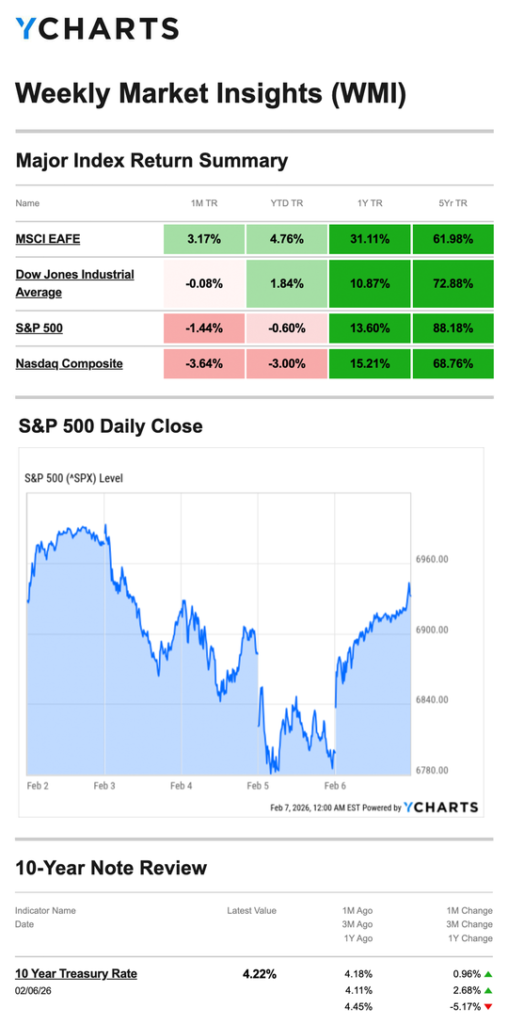
Source: YCharts.com, February 7, 2026. Weekly performance is measured from Monday, February 2, to Friday, February 6. TR = total return for the index, which includes any dividends and cash distributions during the period. Treasury note yield is expressed in basis points.
What Happened
Monday: Strong Start Markets opened the week with broad gains across all three major averages, as investors entered with optimism ahead of a busy earnings week featuring more than 100 S&P 500 companies reporting.
Mid-Week: Rotation and Anxiety Sentiment shifted quickly on Tuesday as investors appeared to rotate out of technology and into cyclical sectors — areas of the economy more likely to benefit from an improving economic environment. Wednesday brought more pressure when ADP reported that private employers added only 22,000 jobs in January, roughly half of the 45,000 expected. Stocks fell again Thursday, with the S&P 500 briefly turning negative for the year. A separate report from outplacement firm Challenger, Gray & Christmas showed companies cut more than 108,000 jobs in January — the highest January layoff count since 2009.
Friday: Buyers Return, Dow Hits 50,000 Markets rebounded broadly to close the week as investors appeared to step in and buy the dip. The Dow led, closing above 50,000 for the first time. The Nasdaq reclaimed 23,000, and the S&P gained roughly 2% on the day. A University of Michigan survey showing consumer sentiment at a six-month high helped lift the mood heading into the weekend.
The Fed Holds Steady The January meeting marked the first time the Fed paused since July, ending a run of three straight rate cuts. With the next Fed meeting not until mid-March, markets will have several weeks of data — including this week’s jobs report — to recalibrate expectations around the pace of future cuts.
The Jobs Picture: Complicated The week’s labor market data sent conflicting signals that investors are still working to reconcile. Private payroll growth was less than half of what was expected. January layoffs hit a 16-year high for the month. Yet the Fed’s most recent post-meeting statement described job gains as “low” with “some signs of stabilization” — language that suggests the central bank is watching carefully but not yet alarmed.
One additional wrinkle: the government’s official January employment report, originally due Friday, was delayed by the recent government shutdown and is now scheduled for release this Wednesday. That report will be the most complete read on the labor market and will draw significant attention from both investors and Fed officials.
What We’re Watching
Wednesday’s Jobs Report The delayed federal employment report is the week’s centerpiece. Given the conflicting private-sector data from last week, the official numbers could meaningfully shift expectations around the Fed’s next move.
Friday’s CPI Inflation data arrives at the end of the week, and with the Fed already in a holding pattern, any surprise in either direction could move markets. A cooler reading would be welcomed; a hotter one would add to the uncertainty.
The Rotation Trade Last week’s divergence between the Dow and Nasdaq bears watching. If investors continue shifting from growth-oriented tech into cyclicals and value, it could represent a broader rebalancing of market leadership — not just a one-week blip.
This Week’s Critical Data
- Wednesday: Federal Employment Report (January, delayed)
- Friday: Consumer Price Index (CPI)
Note: Several reports reflect delayed publication from the recent government shutdown.
Source: Investors Business Daily – Econoday economic calendar; February 6, 2026. Forecasts are subject to revision and may not materialize.
As always, if you have any questions about your portfolio or want to discuss your strategy, please don’t hesitate to reach out.

Crescent Private Wealth
Weekly Market Insights
Talk To Us!
Footnotes And Sources
WSJ.com, February 6, 2026
Investing.com, February 6, 2026
CNBC.com, February 2, 2026
CNBC.com, February 4, 2026
CNBC.com, February 5, 2026
WSJ.com, February 6, 2026
CNBC.com, February 4, 2026
CNBC.com, February 5, 2026
CNBC.com, January 28, 2026
IRS.gov, July 8, 2025
Investing involves risks, and investment decisions should be based on your own goals, time horizon, and tolerance for risk. The return and principal value of investments will fluctuate as market conditions change. When sold, investments may be worth more or less than their original cost.
The forecasts or forward-looking statements are based on assumptions, may not materialize, and are subject to revision without notice.
The market indexes discussed are unmanaged, and generally, considered representative of their respective markets. Index performance is not indicative of the past performance of a particular investment. Indexes do not incur management fees, costs, and expenses. Individuals cannot directly invest in unmanaged indexes. Past performance does not guarantee future results.
The Dow Jones Industrial Average is an unmanaged index that is generally considered representative of large-capitalization companies on the U.S. stock market. The Nasdaq Composite is an index of the common stocks and similar securities listed on the Nasdaq stock market and considered a broad indicator of the performance of stocks of technology and growth companies. The MSCI EAFE Index was created by Morgan Stanley Capital International (MSCI) and serves as a benchmark of the performance of major international equity markets, as represented by 21 major MSCI indexes from Europe, Australia, and Southeast Asia. The S&P 500 Composite Index is an unmanaged group of securities that are considered to be representative of the stock market in general.
U.S. Treasury Notes are guaranteed by the federal government as to the timely payment of principal and interest. However, if you sell a Treasury Note prior to maturity, it may be worth more or less than the original price paid. Fixed income investments are subject to various risks including changes in interest rates, credit quality, inflation risk, market valuations, prepayments, corporate events, tax ramifications and other factors.
International investments carry additional risks, which include differences in financial reporting standards, currency exchange rates, political risks unique to a specific country, foreign taxes and regulations, and the potential for illiquid markets. These factors may result in greater share price volatility.